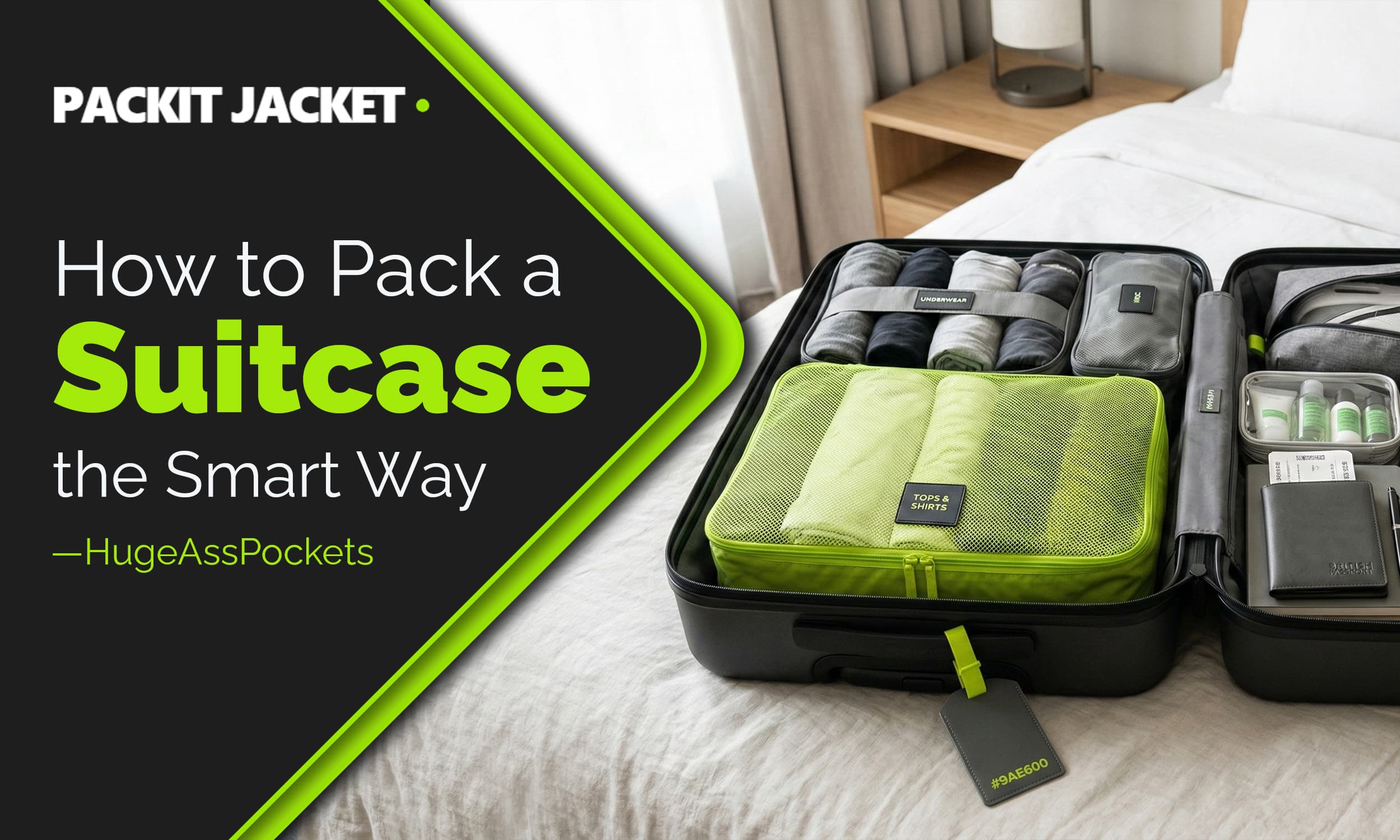
Most travelers usually pack their luggage incorrectly and end up paying extra for an overweight bag at the airport. Overpacking can cost you money, time, and energy. And the worst part? You probably only wear 60–70% of what you bring.
In this guide, you'll learn how to pack luggage for travel or for air travel so you can avoid baggage fees, maximize carry-on space, and stop dragging around unnecessary stuff.
How to pack luggage efficiently (Quick Summary)
- Plan your outfits by day or need
- Lay everything out and cut 20–30% before packing
- Use packing cubes to compress and better organize your stuff
- Pack your suitcase smartly by placing heavy items at the bottom and delicate items at the top
- Wear bulky items like jackets instead of packing them
What Most Travelers Get Wrong About Packing
A lot of travelers overpack because they fall into the 'just in case' mindset, tossing in extra and heavier items instead of sticking to a simple capsule wardrobe or using tools like packing cubes. They end up packing for a fantasy version of the trip, forget to choose pieces that actually mix and match, and sometimes even bring luggage that doesn't really suit the trip.
The Real Cost of Overpacking: Fees, Fatigue, and Wasted Time
Airlines collected over $7 billion in baggage fees in recent years. That reflects an overpacking culture on a global scale. But the hidden cost is far worse.
Heavy bags mean:
- You end up paying overweight fees you didn't expect
- You stand around the baggage claim while carry-on travelers are already in a taxi
- You drag a heavy suitcase up hotel stairs or across cobblestone streets
- You suffer from unnecessary fatigue, and your suitcase gets damaged easily
And all of it could've been avoided with a little restraint and smart packing before the trip.
The Mindset Shift: Pack Outfits, Not Individual Items
Most overpacking starts with a simple mistake: you pack by category instead of by purpose. You count items and assume you're covered. When you don't think in terms of complete outfits, you end up having more duplicates in your suitcase.
The mindset shift is straightforward: plan outfits, not items.
- Start with a quick day-by-day list of your trip and note what you'll wear for each activity.
- From there, look for overlap. For example, can the same shoes work for multiple outfits?
- The goal isn't to create completely separate ensembles for every occasion but to build combinations that share items.
- Also, create lists of outfits, such as: Day 1: Travel outfit; Day 2: Hiking outfit; Day 3: Dinner outfit.
When you pack this way, redundancy becomes obvious. And once you eliminate those extra 'backup' items, you naturally reduce bulk, weight, and decision fatigue.
How to Pack a Suitcase Step-by-Step
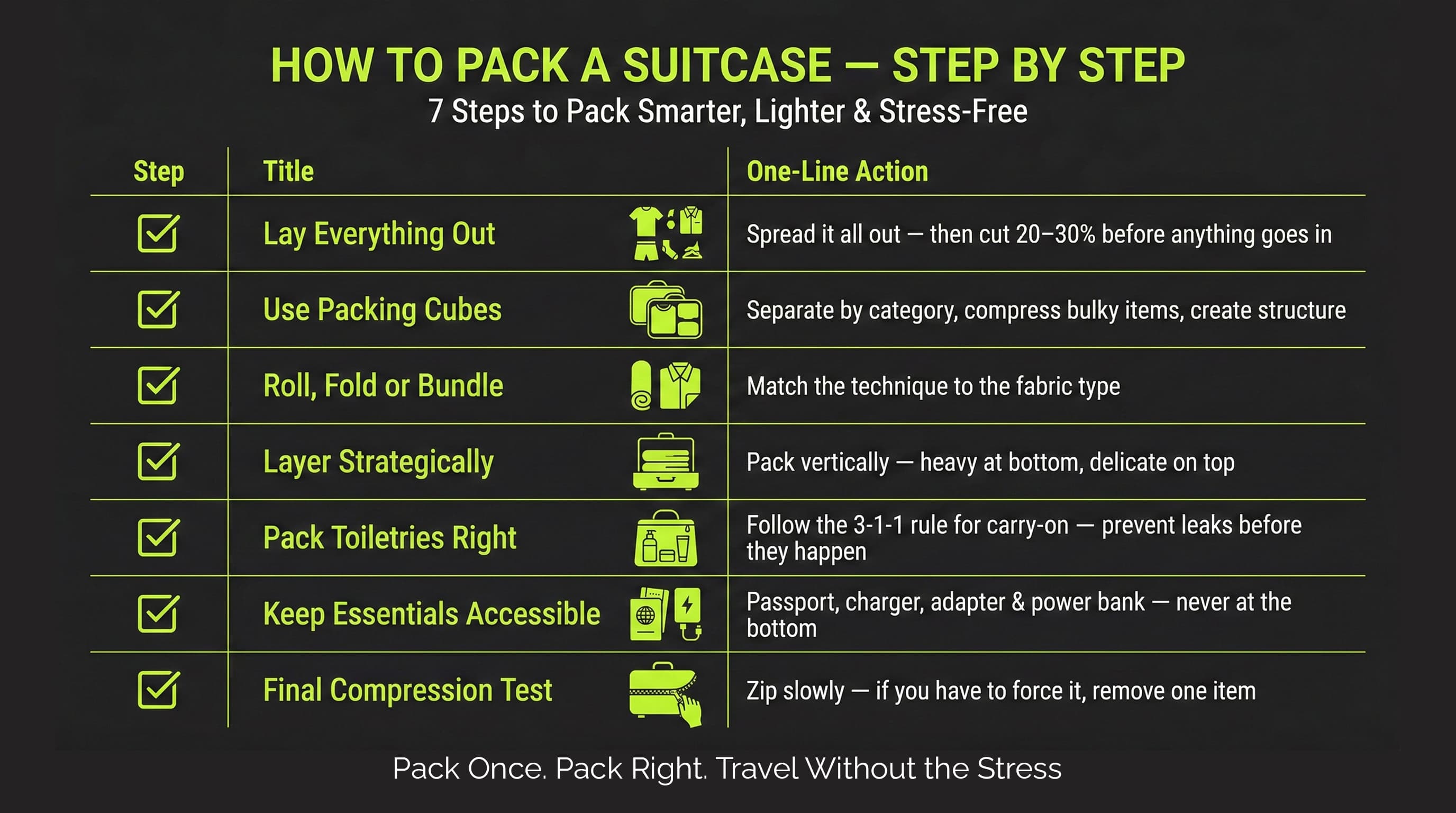
Step 1—Lay Everything Out Before Anything Goes In
Before you start packing, lay out everything you plan to carry along. This does two things: it forces a visual audit and makes your packing list real instead of theoretical.
Now here's the important part: cut 20–30%. You will surely see duplicates. For example, you might have laid out two black sweaters and three tops when you only needed one or two.
Step 2—Use Packing Tools to Organize Your Stuff
Once you've planned your outfits, the next step is to pack them in an organized fashion. Here are a few simple tools that can help you achieve that:
- Packing Cubes: These help you organize your clothes by outfit or type.
- Compression Bags: These squeeze out the extra air, making them perfect for packing bulky items like sweaters.
- Garment Folders: They protect delicate items from getting wrinkled.
- Luggage Scale: Use it to check your bag's weight before leaving for the airport to avoid surprise fees.
Step 3—Roll, Fold, or Bundle? Match the Technique to the Item
Here's how to decide what technique to use:
Roll: T-shirts, knit dresses, leggings, casual cotton items. Rolling reduces wrinkles in soft fabrics and fits easily inside packing cubes.
Fold: Blazers, structured pants, dress shirts, stiff fabrics. Structured items crease less when folded cleanly along natural seams.
Bundle wrap: For suits or formalwear, bundle wrapping or layering garments around a central core (like a pouch of underwear or socks) minimizes sharp folds. This works especially well for business travel.
Step 4—Layer Your Suitcase Strategically
Pack your suitcase vertically, not horizontally. This keeps the center of gravity low and protects delicate items from pressure.
Bottom (wheel end): Shoes (in bags or shower caps), heavier items like jeans.
Middle layer: Rolled clothes inside packing cubes, softer, flexible pieces.
Top layer: Wrinkle-prone items, blazers, dresses, button-down shirts.
Very top/easy access area: Toiletry bag, anything you may need quickly.
Step 5—Pack Toiletries Without the Mess or TSA Issues
For carry-ons, remember the 3-1-1 rule:
- 3.4 oz (100 ml) max per container
- 1 quart-sized clear bag
- 1 bag per passenger
Here are some leak-proofing tricks that can prevent a disaster at the airport:
- Put plastic wrap under bottle caps before tightening
- Use zip-top bags even inside your toiletry pouch
- Tape over flip-top lids
If you want to save more space, you can buy toiletries at your destination. Always keep toiletries in a separate, removable bag so it's easier to take them out when needed.
Step 6 — Keep Electronics and Documents Within Easy Reach
Don't pack essentials like passports, phone chargers, portable batteries, and travel adapters (always check plug type for your destination before leaving) at the bottom of your suitcase. Keep these items in an outer suitcase pocket or, ideally, on your body.
Step 7 — The Final Compression and Close Test
Once everything is inside, use the suitcase compression straps and zip it slowly. If you have to force close the bag, remove one item from it. If the zipper feels stressed now, it will definitely fail after being tossed by baggage handlers.
Here's another instant space hack most travelers overlook: wear your bulkiest items on the plane. A single jacket can easily account for 3–5 pounds of luggage weight. Wearing it instead of packing it can be the difference between carry-on only and checking a bag.
Frequent travelers take this further with multi-pocket travel jackets like the Packit Jacket. These jackets are designed to hold essentials in secure compartments, helping you save tons of space in your luggage.
Quick Packing Checklists by Trip Type
Every trip has different packing priorities. Refer to these quick checklists to adjust what you bring based on the type of trip, expected weather, and dress requirements, not just how many days you'll be away.
Weekend Trip (2–3 Days)
Goal: One bag. No checking luggage. In and out fast.
- 2 daytime outfits that share the same bottoms
- 1 evening option (swap the top, keep the shoes)
- 1 light layer (denim jacket, cardigan, hoodie)
- Small toiletry kit
Beach Vacation
Goal: Light fabrics. Fast drying. Minimal bulk.
- 2–3 swimsuits (because they don't dry instantly)
- 1–2 cover-ups that double as a casual outfit
- Sandals or flip-flops
- Quick-dry shorts and breathable tops
- Reef-safe sunscreen (you can also buy it at the destination)
Another mistake people often make is packing too much beach gear, like towels and extra sandals, that they can also buy cheaply at the destination.
Business Trip
Goal: Look sharp. Carry less.
- 1 suit or blazer that works with 2–3 shirts
- Wrinkle-resistant fabrics
- Fold clothes along their natural seams and keep collars and lapels supported using tissue paper or thin packing sheets to prevent wrinkles
- 2 pairs of shoes max (wear the heavier pair in transit)
One well-planned suit combination beats three backup outfits you'll never wear.
Long or Multi-Climate Trip
Goal: Layer smart. Don't pack heavy.
- Base layers (lightweight, moisture-wicking)
- Mid-layer (sweater or fleece)
- Outer shell (waterproof or wind-resistant)
- Neutral bottoms that work in multiple settings
Instead of packing one massive winter coat, carry layers. Base + mid + outer shells cover most climates.
How to Avoid Baggage Fees While Packing
Most baggage fees result from poor packing decisions. Two strategies make the biggest difference.
Wear Your Luggage: The Travel Jacket Trick
Smart travellers have a trick up their sleeve. They wear the heaviest articles of their outfit. Boots, a hoodie, a thick sweater, a winter coat, etc. Because what's on your body doesn't count toward suitcase weight. That alone can free up 3–5 pounds instantly, sometimes enough to avoid checking a bag entirely.
Purpose-built travel jackets like the Packit Jacket are designed to solve a common travel frustration: limited carry-on space. Instead of stuffing your bag with small essentials, you can distribute items like your phone, charger, tablet, passport, power bank, and travel documents directly into intelligently placed pockets.
A well-designed wearable luggage jacket can comfortably support up to 10–15 lbs (4.5–7 kg) of evenly distributed weight, depending on the model and pocket layout. That means you free up valuable space in your carry-on while keeping your most important items accessible, organized, and secure. If you're curious about how this works in practice, explore the full benefits of a travel jacket — from weight distribution to pocket organization and beyond.
Use Your Personal Item Allowance Strategically
Most people waste their personal item allowance. They toss in a laptop, maybe a snack, and that's it. That's a mistake.
Most airlines allow a personal item around 18 x 14 x 8 inches. That's not tiny. A structured backpack that fits those dimensions can hold:
- 1–2 days of clothes
- All essential electronics
- Toiletries
- Documents
If packed intentionally, your personal items can eliminate the need for a checked bag.
5 Packing Mistakes That Cost You Time and Money
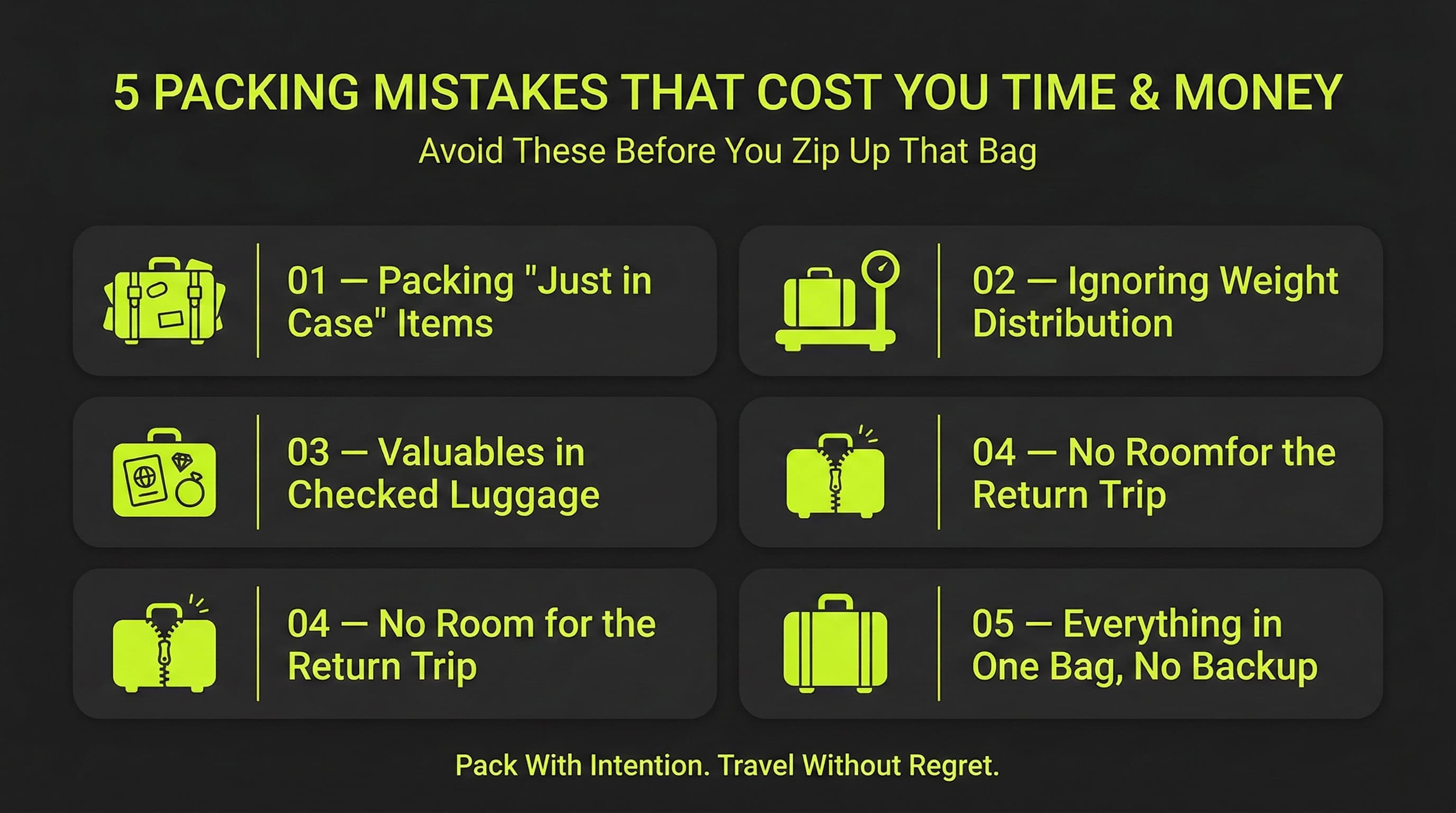
1. Packing "Just in Case" Items
The "what if" mindset is the biggest mistake of all. If you won't wear it at least twice, it probably shouldn't be a part of your luggage.
Those "just in case" items, like an extra pair of shoes, a backup jacket, and a third pair of jeans, can add up to 5-10 lbs in your luggage.
2. Ignoring Weight Distribution
If you ever had a suitcase that kept tipping over, poor weight distribution was the most probable cause. Keep the center of gravity low. Pack shoes and heavy items at the bottom (near the wheel end) and lighter layers at the top.
3. Putting Valuables in Checked Luggage
This should be obvious, but people still make this mistake often. Electronics, medication, important documents, and jewelry all need to go in the carry-on. Always.
Bags often get delayed or, in some cases, are lost. It's rare, but when it happens, it's bound to create a mess for you.
4. Not Leaving Room for the Return Trip
If your suitcase is packed to its full capacity on the way out, you'll face difficulty on your way back. You will probably buy stuff like snacks, souvenirs, and gifts on your trip. Always try to leave 15–20% space open for such stuff. You could even pack a small foldable tote in case you need overflow room.
5. Packing Everything in One Bag With No Backup Plan
If you're checking a bag, you should carry at least one outfit in your carry-on. Same with basic toiletries and essentials. If your checked bag is delayed, you'll be stuck wearing the same clothes for who knows how long.
Frequently Asked Questions
What is the best way to pack a suitcase to save space?+
What should I always keep in my carry-on bag?+
Can you use a jacket instead of a carry-on bag?+
How do packing cubes work, and are they worth it?+
How far in advance should I start packing?+
What's the best way to pack shoes without ruining other clothes?+
Pack Less, Travel Better
The verdict? Always pack with intention, choose items strategically, and resort to smart tools to save space.
Smart packing is all about being intentional. Plan by outfit, not by individual pieces. Layer your suitcase strategically so everything has a place, so you can access what you need without unpacking half your bag. And whenever possible, wear your heaviest items instead of packing them.
The best packers aren't the ones carrying the most luggage; they're the ones who bring exactly what they need.
If you want an extra advantage, a practical hack is to use a travel jacket like the Packit Jacket from Huge Ass Pockets. With thoughtfully designed pockets that hold your everyday essentials, it turns your jacket into functional storage and frees up space in your carry-on.