In 2024 alone, U.S. airlines pulled in $7.27 billion just from checked baggage fees, according to the Bureau of Transportation Statistics. And that doesn't include charges from upgrades or seat selection. Just luggage!
And if you've flown recently, you've probably felt it. It's never just one fee. You check one bag, fine. Then you realise the second bag costs more. You're two pounds over the weight limit, and there's another charge. You buy a few things on vacation, and suddenly your return flight costs more than your outgoing one. Even a carry-on can become a problem if it doesn't fit the sizer at the gate.
It can feel random, but it's not. Airlines are very consistent about how they charge. Once you see the pattern, it's actually pretty easy to work around it.
That's what this guide is about. We are going to walk you through 10 practical ways to avoid baggage fees. But if you just want the essentials, here are a few quick tips:
- Book with airlines that include free checked bags.
- Use a travel credit card that covers your first bag.
- Sign up for the airline's loyalty program.
- Stick to carry-on only whenever you can.
- Don't exceed the size or weight limit.
- Wear heavier items instead of packing them in your suitcase.
- Use your travelling companion's baggage allowance wisely.
What Baggage Fees Really Cost You in 2026
When flying with legacy airlines, the first checked bag is usually around $35–$40, the second one about $45–$50. Not huge if it's just you, but if you've got a family or a couple of extra bags, it piles up fast.
Budget airlines are a different story. The ticket might look cheap, but the bags can cost way more, sometimes $40–$75 for the first one, and that's if you buy it in advance. Carry-ons? Not always free. Suddenly, that "cheap" flight isn't looking so cheap anymore.
Take the example of a family of four checking a bag each on a round trip with a legacy carrier. You're looking at something like $280 on bags alone. And that's before a second bag is even added. Go over the weight or size limit, and that's another $100 or more per bag. Fees start stacking faster than you'd expect.
So why do airlines keep raising the fees? Because they're making a ton of money from it. Most of us just look at the ticket price. Keep it low, then make extra cash on everything else — bags, seats, snacks, whatever they can charge for.
2026 Airline Baggage Fee Comparison
| Airline | Carry-on | 1st Checked | 2nd Checked |
|---|---|---|---|
| Southwest | Free | $35 | $45 |
| Delta | Free | $35–$40 | $45–$50 |
| United | Free | $35–$40 | $45–$50 |
| American | Free | $35–$40 | $45 |
| JetBlue | $0–$65 | $35–$40 | $45–$50 |
| Spirit | $39–$65 | $40–$75 | $50–$90 |
| Frontier | $39–$65 | $40–$75 | $50–$90 |
Fees current as of Feb 2026. Always verify directly with your airline before flying, as airline policies vary by route and fare class. Budget carriers charge more if you pay at the airport or gate. Online prepayment is usually cheaper.
Before You Book: Set Yourself Up to Fly Bag-Free
The easiest way to avoid baggage fees? Don't wait until you're at the airport shoving clothes into a carry-on. It starts before you even book your flight.
Tip 1: Pick Airlines That Include Free Bags
Some airlines still give you a couple of free checked bags. Southwest, for example, allows two free checked bags, no strings attached (for most fare types). While most legacy carriers like Delta or American still include at least a free carry-on with your ticket, except for some basic economy fares.
The key is simple: don't just compare ticket prices. A $30 "cheaper" flight that charges $70 for bags? Not really cheaper. Always look at the total trip cost, not just the base fare.
Tip 2: Use a Credit Card That Waives Baggage Fees
If you fly often, an airline credit card can cover its cost pretty fast. Cards like Delta SkyMiles, United Explorer, or American Airlines AAdvantage often include at least the first checked bag free for you and even sometimes for your travel companions, too.
Some travel cards also give you airline fee credits. The catch? Check the annual fee versus how much you actually travel. If you're flying twice a year, it might not make sense, but for frequent travellers, it's a good thing to have.
Tip 3: Join the Airline's Loyalty Program (Even the Free Tier)
Signing up for the free loyalty program can prove beneficial. Many airlines offer perks like a free checked bag once you hit a certain tier, and sometimes even the base membership has benefits you wouldn't get otherwise.
If you fly the same airline a few times a year, you could earn a mid-tier status without much effort, which usually includes one or two free checked bags. If you plan smartly, you can save a lot over the course of a year.
Before You Pack: Know the Rules and Gear Up
Tip 4: Check Your Airline's Baggage Policy Every Time
It's a good thing to know what your airline actually allows before you even start packing. Policies change all the time, so don't trust a quick Google search or what you remember from last year. Go straight to the airline's website and check your fare class.
Rules can differ on a basic economy ticket, a domestic flight, or a connecting trip on a partner airline.
Pro tip: screenshot the rules and save them on your phone. That way, if a gate agent questions your bag, you've got the proof right there.
Tip 5: Choose a Bag That Maxes Out the Size Limit
Go for a bag matching the maximum carry-on dimensions, usually around 22 x 14 x 9 inches (56 cm x 36 cm x 23 cm). If it has expandable features or compression options, it can help you carry more stuff. Avoid bags that bulge out so you don't end up paying extra at the gate.
Tip 6: Weigh Your Bags Before You Leave Home
A portable luggage scale is cheap, around $10–$15, and it can save you a fortune. Overweight fees are brutal, often $50–$150 per bag. Weighing everything the night before and leaving a little room for souvenirs or heavier items you pick up on the trip can go a long way.
Packing Strategy: How to Fit More in Less Space
Tip 7: Pack Light with the 5-4-3-2-1 Rule
You won't need much on most trips: 5 tops, 4 bottoms, 3 accessories, 2 pairs of shoes and 1 jacket are usually it. Roll clothes instead of folding them and store them in packing cubes to save more space.
Tip 8: Carry-On Only (Even for a Week)
Travel light. Stick to a capsule wardrobe, use travel-size toiletries, and prefer washing a couple of clothing items instead of carrying extra. A small, well-packed bag is surprisingly enough for 5–7 days.
Tip 9: Wear Your Bulkiest Stuff
Wear big coats, boots and hoodies instead of packing them. Some travellers take this a step further with the Packit Jacket, which has extra pockets and compartments to carry all your essentials instead of packing them in your bag. It's the perfect way to keep your carry-on light and avoid extra baggage fees.
Tip 10: Share Baggage With Your Travel Buddy
Flying with someone? Spread it out. Airlines only care about weight and number of bags per ticket, not who's carrying what. If one person has a free checked bag or elite status, pack a little heavier in their bag.
Bonus Tips: Last-Minute Moves at the Airport
Get Your Bag Gate-Checked for Free
Sometimes, when the flight is full, the airline asks for volunteers to gate-check carry-ons. If you don't need your bag urgently, this is a free way to avoid paying for a checked bag. Just don't expect to have it during the flight.
When Shipping Beats Flying With It
If you've got something really heavy or oddly shaped, like sports gear, musical instruments, or multi-week trip luggage, shipping can actually be cheaper than checking it. USPS flat rate boxes or other shipping services can help you save baggage fees, but for a normal suitcase, it's almost always cheaper to pack smart and avoid checking altogether.
5 Common Baggage Fee Mistakes (and How to Avoid Them)
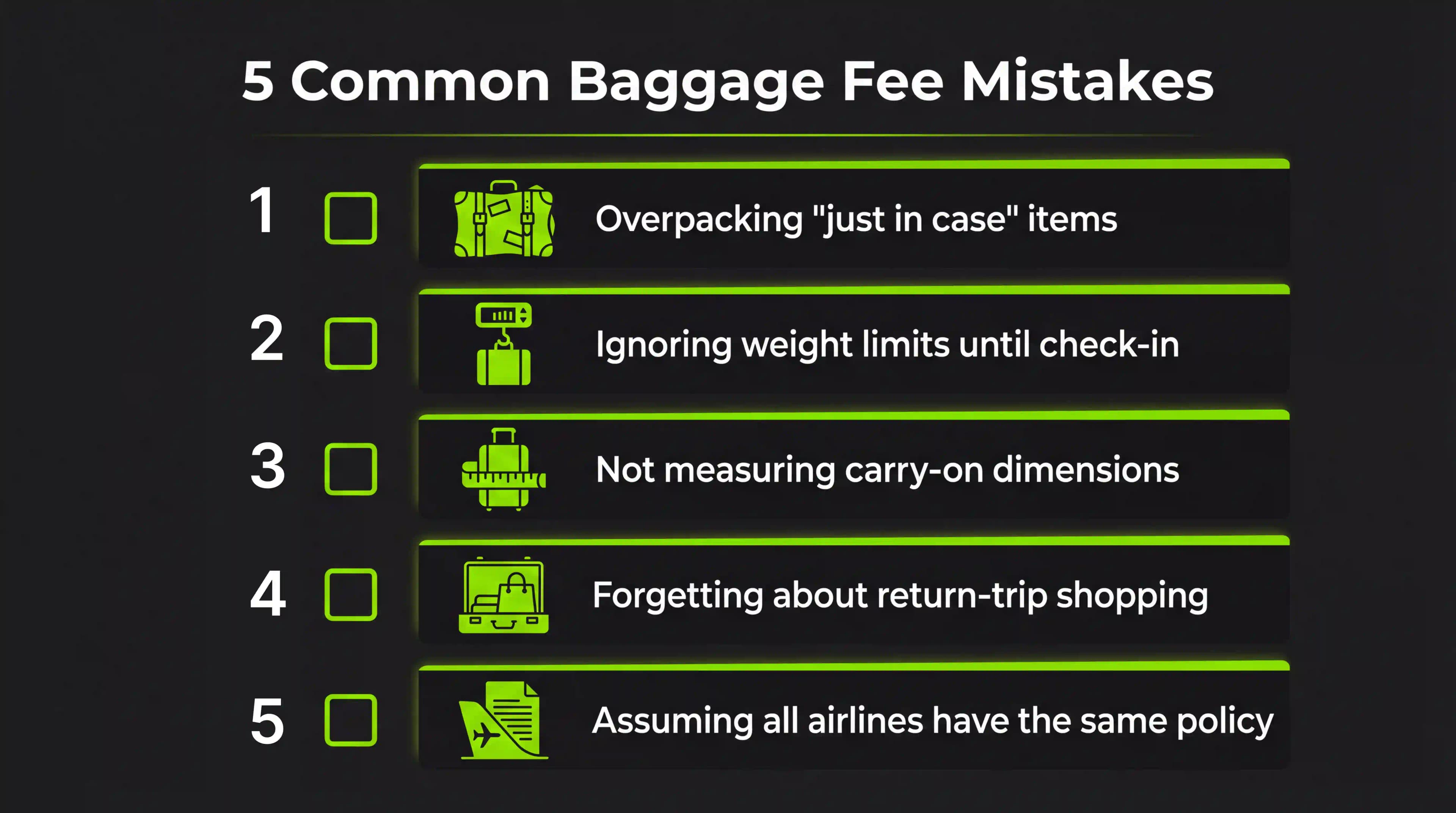
Even seasoned travellers mess this up sometimes. These are the ones that sneak up and cost real money.
Overpacking "Just in Case" Items
We all do it. You might think, "I might need this, or that", and you end up with a bag that is heavier than you intended it to be. Rule of thumb: if you won't use it at least twice on the trip, leave it.
Ignoring Weight Limits Until Check-In
Weighing your bag at the airport is stressful and expensive. Portable scales are cheap, and using one at home can save you from $50–$150 overweight fees. Trust us, it's worth it.
Not Measuring Carry-On Dimensions
Airlines enforce those size boxes, especially budget carriers. Even one inch too tall or too wide can cost you a $65 gate fee. So it's always better to measure your bag before you leave.
Forgetting About Return-Trip Shopping
Your bag fits perfectly on the way there, but will it fit on the return flight with all the souvenirs, gifts, or shopping you pick up? If not, leave some space for these things.
Assuming All Airlines Have the Same Policy
Just because a certain airline gives you a free bag doesn't mean your connecting flight on a partner airline does. Each airline has its own rules, and connecting flights can mix fare classes. Check every segment before assuming you're covered.
FAQs
What if my bag is just a little overweight?+
Personal item vs. carry-on — what's the difference?+
Can I pay for baggage at the airport?+
Do baggage fees change for international flights?+
Which airlines still let you check bags for free?+
Fly Smarter, Not Heavier
At the end of the day, avoiding baggage fees is all about knowing stuff and planning smartly. Three things really make the biggest difference:
Know the rules before you book. Check the airline's baggage policy, compare total costs, and use any perks you have. Pack intentionally. A carry-on can cover most trips if you pack smartly. Use loyalty programs, credit cards, and smart gear.
Speaking of smart gear, travellers love the Huge Ass Pockets' Packit Jacket. With tons of pockets and compartments, you can carry all your essentials right on your body, keeping your bag light and fees minimal. Seriously, it's like having a mini bag you wear.
Do this, and you'll walk past the baggage counter feeling like you just hacked the system!