
Why the Right Travel Jacket Matters
When someone asks, "What jacket works for travel?", what they really want is that one jacket they can throw in a carry-on without sacrificing half their space. Something that works on a chilly morning walk, doesn't look weird at dinner, and can handle whatever weather they encounter on the trip.
Get it wrong, though, and you'll be adjusting your luggage the entire trip.
The Cost of Getting It Wrong
Most travel jacket mistakes fall into one of three categories.
1. Overpacking because you don't trust your jacket. If your jacket only works in one condition, you compensate by bringing backups.
2. Overheating because you are wearing the wrong jacket. A heavy winter coat on a warm day? You'll be miserable. No layer on a chilly long-haul flight? Equally miserable.
3. Being caught unprepared in changing weather. When you don't think through your destination, your itinerary, and your layering plan, you end up either uncomfortable or shopping abroad at inflated prices.
What Makes a Jacket "Travel-Ready" vs. Just a Regular Jacket?
Not every good jacket is a good travel jacket. A true versatile travel jacket checks specific boxes:
- It packs small.
- It adapts to multiple temperatures.
- It handles light weather shifts.
- It layers easily.
- It doesn't look awkward or out of place.
A regular winter coat is built for just one job — to keep you warm in consistent cold. The best jacket for travel isn't necessarily the warmest or the most waterproof. It's the one that gives you flexibility without adding additional weight or bulk.
The 5 Key Features to Look for in a Travel Jacket
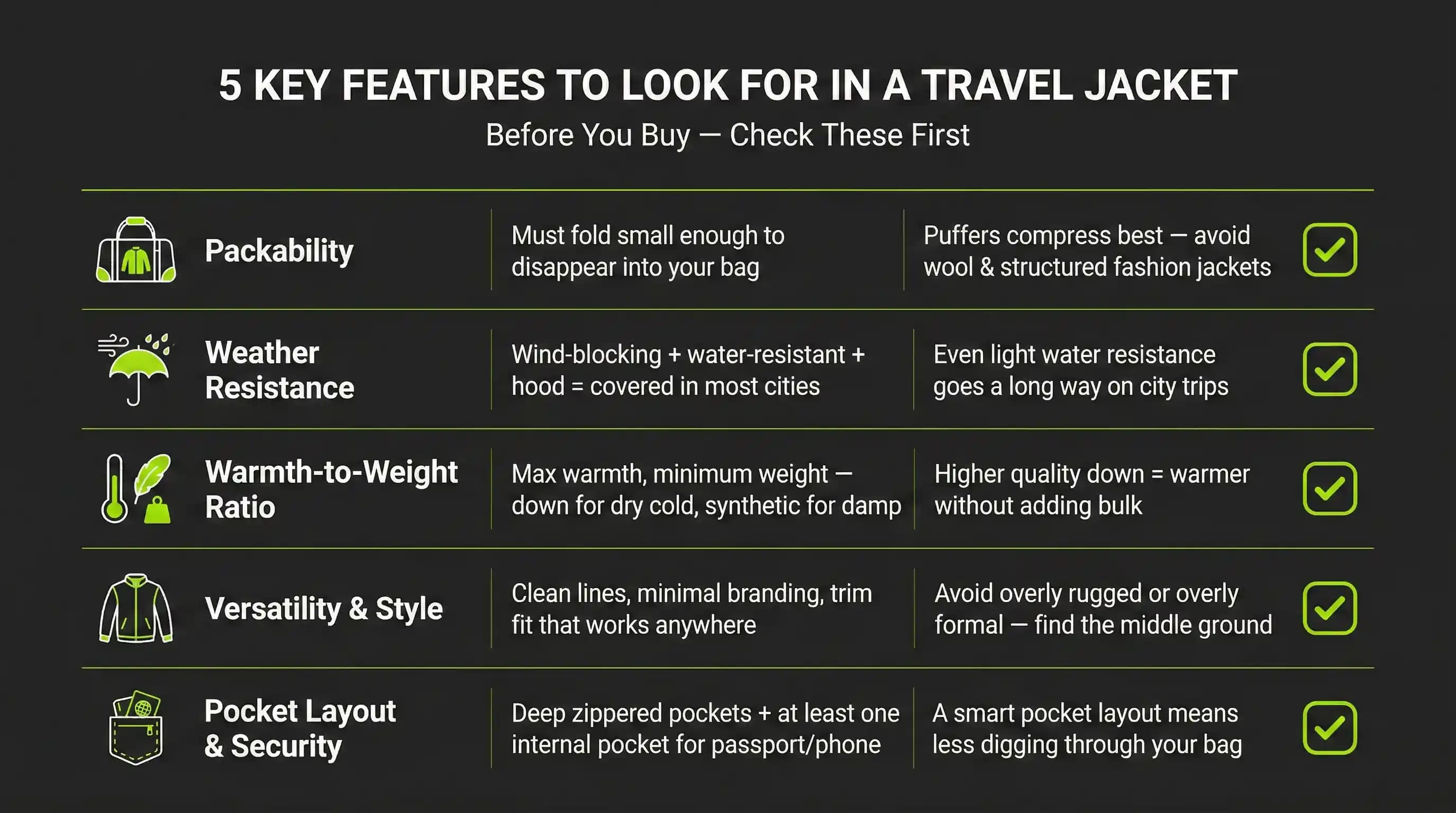
If you're wondering what jacket works for travel, this is where you start.
Packability
Start with the basics. If your jacket doesn't pack down small, it will eventually frustrate you. Airports, trains, cafés — you'll take it off at some point. And when you do, it needs to disappear into your bag without taking up all the space inside.
Down and synthetic puffers usually flatten down impressively small, while heavy wool coats and structured fashion jackets are not built for this.
Weather Resistance
Most trips usually require a certain degree of water resistance. A jacket that blocks wind and handles moderate rain will cover you in most cities. Add a hood, and you've already increased your margin of safety.
Warmth-to-Weight Ratio
Warmth-to-weight ratio means how warm the jacket keeps you compared to its weight. High-quality down provides better warmth without much weight, whereas synthetic insulation handles moisture better.
Versatility and Style
This is where many jackets fall behind. Some are technically great but look overly rugged, while others look sharp but fall apart in real weather.
A versatile travel jacket is the one that finds the middle ground. Clean lines, minimal branding, a trim but comfortable fit that allows for layering.
Pocket Layout and Security
A good travel jacket should have secure deep or zippered pockets and at least one internal pocket for essentials like your passport or phone. A well-thought-out pocket layout saves you from constantly digging into your bag.
Price vs. Value
You don't need the most expensive jacket on the market, but you do need one that you can rely upon in every kind of situation.
You should pay more for practical features like better insulation, durable stitching, quality zippers, and water resistance — not just for the logo.
How to Choose a Travel Jacket Based on Your Destination Climate
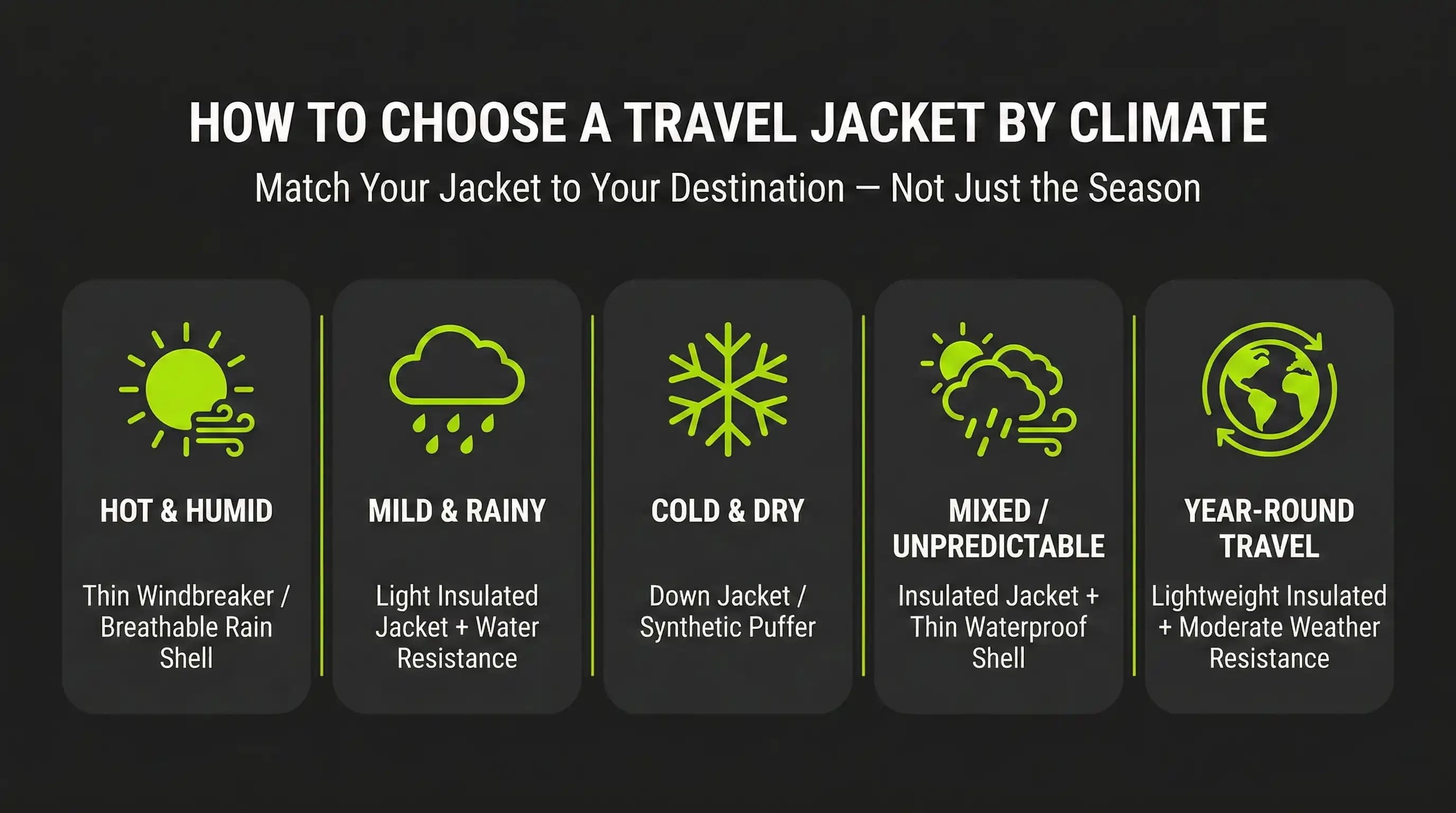
The right choice while choosing a travel jacket depends heavily on the climate.
Hot and Humid Climates
If you're heading somewhere tropical or humid, you should focus on airflow and surprise rain rather than warmth. A thin windbreaker or breathable rain shell works well here. In humid conditions, thick fabrics feel suffocating — stick to lightweight, breathable materials that don't trap heat.
Mild and Rainy Climates
A light insulated jacket paired with solid water resistance usually works best in these weather conditions. You don't need too much warmth. You just need protection from damp air and wind chill.
If rain is frequent, prioritize a waterproof outer shell; if it's more of an intermittent drizzle, strong water resistance will likely suffice.
Cold and Dry Climates
A well-insulated down jacket or a synthetic puffer jacket usually works well in these scenarios. People usually overpack for such weather because they assume colder automatically means they need a thicker and heavier jacket. However, layering with a high-quality insulated jacket often works better than wearing one massive coat.
Mixed or Unpredictable Weather
A lightweight insulated jacket paired with a thin waterproof shell gives you flexibility. Some travelers prefer a 3-in-1 style system for this reason. Others prefer two separate layers they can mix and match.
Year-Round Travel
If you travel often and want one jacket that works in multiple climates, you need a lightweight insulated jacket with moderate weather resistance. You can pair it with a smart base and mid-layers and use it in more than one climate.
This approach simplifies packing and keeps you comfortable in 90% of the situations you'll realistically encounter.
What Type of Jacket Works Best for Different Travel Styles?
Every traveller moves in their own way. So instead of chasing a single perfect option, matching your jacket to how you travel makes much more sense.
| Travel Style | Best Jacket Type | Why |
|---|---|---|
| Business Travel | Packable blazer-style or slim puffer | Professional look, compresses easily |
| Backpacking | Packable down or synthetic puffer | Lightweight, multi-use layering |
| Beach/Tropical | Lightweight windbreaker or rain shell | Handles AC & sudden rain |
| Cold Weather Trips | 3-in-1 or insulated shell | Handles real winter temps |
| City Hopping | Versatile softshell or trench | Stylish, light protection |
| Adventure/Hiking | Hardshell or fleece-insulated jacket | Durable, weatherproof |
Travel Jacket Tips for Flying and Airport Security
Airports are where your travel jacket either proves itself or becomes a nuisance.
How to Get Through TSA Without Removing Your Jacket
First, the honest answer: most of the time, you'll still need to remove it. But lightweight jackets with minimal metal hardware move through security more smoothly. If your jacket is thin and unstructured, it's easier to slide into a bin and put back on quickly.
Empty your pockets and keep your essentials in one secure internal pocket before you reach the scanner.
Best Jacket Features for Long-Haul Flights
Temperature varies a lot during long-haul flights so a travel jacket for all weather conditions should handle most temperature variations.
Look for soft lining around the collar. That small detail makes a big difference when you have to lean back for hours. Lightweight insulation is preferable over thick padding as it keeps you warm without feeling restrictive in a tight seat.
Smartly placed deep pockets are also useful mid-flight as they let you store your essentials without constantly reaching into the overhead bin.
How to Use Your Jacket as a Carry-On Layer to Save Bag Space
Your jacket is technically a part of your clothing, not your luggage, so it doesn't count toward carry-on limits. A compressible, versatile travel jacket gives you the flexibility of wearing it, folding it into the seat pocket during the flight, or stuffing it into your backpack.
Some smart travelers take this a step further by choosing travel jackets like the Packit Jacket, designed with large, well-placed pockets that let you carry your essentials on your body.
How to Layer Your Travel Jacket — The 3-Layer System
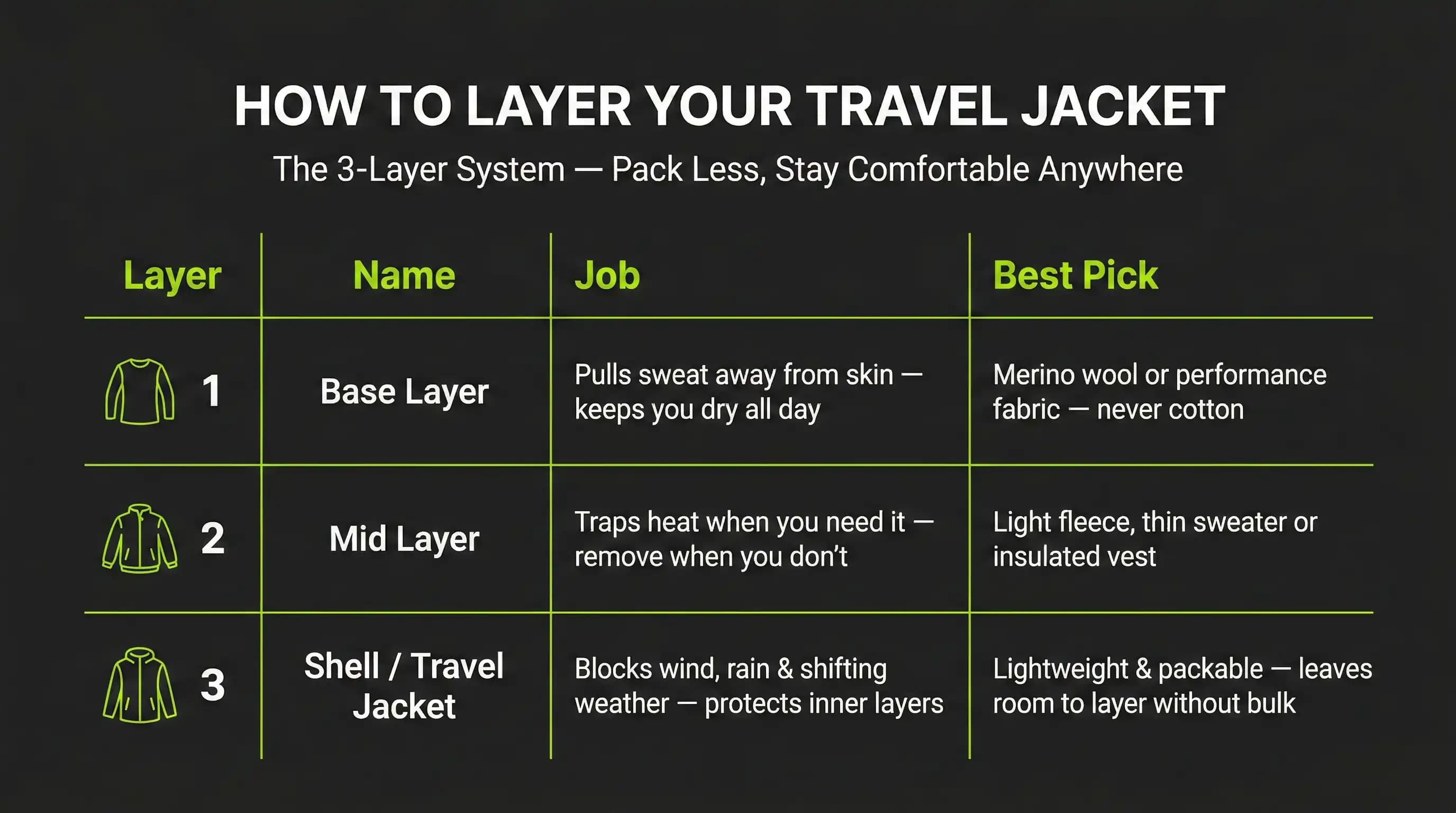
If you're trying to figure out what jacket works for travel, it's rarely just about the jacket — it's about smart layering approaches.
The classic 3-layer system sounds highly effective and simple in practice.
Layer 1 — Base Layer (Moisture Management)
This is the layer closest to your skin, and its job is to keep you dry. When you're walking all day, you sweat, and if it sits on your skin, you'll feel cold later.
Lightweight merino or performance fabric works well. Cotton, on the other hand, doesn't — it holds moisture and takes longer to dry.
Layer 2 — Mid Layer (Insulation)
This is where warmth comes from. Maybe a fleece, a thin sweater or a light insulated vest — nothing bulky. Just enough to trap heat when you need it.
The beauty of a mid-layer is control. Cold outside? Add it. Warm indoors? Take it off. That flexibility matters more than people think.
Layer 3 — Shell (Weather Protection)
This is your actual travel jacket. Its job is to protect you through wind, light rain, and shifting weather. It doesn't need to be heavy. It just needs to block the elements so your inner layers can do their job.
A lightweight travel jacket like the Packit Jacket works best here because it leaves room to layer without feeling tight or bulky.
How to Adjust Your Layers by Climate
Layering doesn't mean wearing everything at once. It's about having flexibility.
Mild weather? Base layer and shell might be enough. Cold and dry? All three layers are outdoors and fewer are indoors. Hot climates? Base layer most of the time, light shell for rain or air conditioning.
Layering for Carry-On-Only Travel
If you want to travel light, this approach makes even more sense. Instead of one heavy coat, you carry along thinner pieces that layer up when needed. You can also wear your bulkiest layer through the airport and free up bag space.
How to Care for and Maintain Your Travel Jacket
A good travel jacket will last years, but only if you treat it properly.
Washing and Drying Instructions by Jacket Type
First rule: always check the label. Down jackets usually need gentle washing with a technical detergent and low heat drying, while synthetic insulated jackets also benefit from mild detergent and low heat but dry faster.
Rain shells and waterproof jackets should be washed occasionally using a cleaner made for technical fabrics, not regular fabric softener. And try not to over-wash.
How to Re-Waterproof a Travel Jacket (DWR Coating Explained)
If your jacket used to repel water and now it soaks through, it's usually the DWR coating that's causing the issue. Over time, this coating wears off, but the fix is simple. After washing, apply a spray-on or wash-in DWR treatment and tumble dry on low heat if the care label allows it.
How to Keep Your Jacket Fresh on Long Trips
Air your jacket out regularly. Don't leave it compressed in your bag for days and hang it overnight if possible, especially after wearing it in humid or rainy conditions.
Spot clean in case of odor instead of doing a full wash. Also, avoid storing it compressed long-term once you're home, especially a down jacket. Let it hang so the insulation keeps its loft.
What to Avoid When Choosing a Travel Jacket
Buying Too Heavy or Too Warm for Your Route
This is the most common mistake. Travelers make assumptions and pack something for extreme cold even when their itinerary doesn't justify it. The result? Overheating, carrying bulk, and barely using the jacket.
Match insulation to your actual destination, not to your assumptions.
Prioritizing Style Over Function
A stylish coat that soaks through in light rain won't do you much good. Style matters, but if it can't block wind, handle drizzle, or layer comfortably, it's not a true versatile travel jacket. You want something that looks good and performs as well.
Ignoring Packability Until It's Too Late
It's easy to overlook it when you're trying a jacket on in a store but once you're traveling, packability becomes critical. If it doesn't fit easily into your bag, you'll end up wearing it just to save some space or struggling to store it. Always think about your suitcase.
Overlooking Pocket Security in High-Risk Destinations
Open pockets may look clean, but they're not practical in crowded environments. If you're heading somewhere busy, secure zippered or internal pockets definitely make a difference. A jacket that works for travel should help you stay secure and organized.
Travel Jacket Packing Tips
How to Pack a Jacket Without Wasting Space
Fold your jacket once or twice neatly and then compress it into its own pocket or a small packing cube. Don't just shove it into your suitcase — it usually creates unnecessary bulk instead of saving space.
If you're using a backpack, place it near the top or in an outer compartment because weather changes abruptly when you are travelling between different places. You don't want to unpack half your bag just to grab it.
And if your jacket refuses to compress or takes up a huge chunk of space, that's a sign. It may not be the right lightweight jacket for travel after all.
Should You Wear or Pack Your Jacket?
When in doubt, wear it to the airport. Even if you take it off at the gate, you've already saved room in your bag. That matters especially if you're traveling carry-on only.
Airports and planes are unpredictable anyway. One minute it's warm and crowded. Next, you're sitting under cold cabin air for hours. Having your jacket on you instead of buried in your luggage just makes things easier.
Frequently Asked Questions
What Is the Single Best Jacket for Travel?+
What Jacket Should I Bring on a Plane?+
What's the Most Versatile Travel Jacket?+
What Jacket Works for Both Hiking and City Travel?+
What Jacket Is Best for Travel in Europe?+
Is a Rain Jacket Good Enough for Travel?+
Should I Bring a Down Jacket When Traveling?+
The One Jacket That Works for Almost Every Trip
If you are still wondering what jacket to carry on your trips, here's the answer: Go with a lightweight, packable insulated jacket that blocks wind, handles light rain, and layers easily. Neutral color and clean design — nothing bulky.
If you like the idea of carrying more without carrying a bag, this is also where something like the Packit Jacket stands out. With smartly placed, huge pockets, it lets you keep essentials on your body without looking stuffed or feeling restricted.
It's time to make the smart choice before your next trip!